
In 2010, a Black shopper at Walmart noticed something striking. The Black Barbie doll was on sale for $3.00. The White Barbie sitting right next to it? $5.93. She took a photo and posted it online. The reaction was immediate and one word kept appearing: disrespectful.
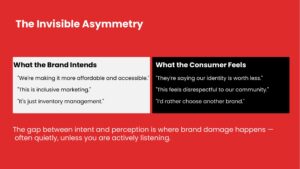
Walmart almost certainly did not intend anything harmful. This was a routine pricing decision. But that didn’t matter. What mattered was what the price communicated and how consumers interpreted it.
This gap between what brands intend and what consumers perceive is where inclusive marketing can quietly go wrong. As a marketer, you may aim to make products more accessible or visible. But do the people you are trying to reach actually feel seen? Or sidelined?
WHAT IS THIS BLOG ARTICLE ABOUT?
- Why discounting identity-linked products can backfire
- Why you might not even notice this happening
- What you can do differently in your pricing and promotions to signal inclusion
THE RESEARCH
A recent study published in the Journal of Marketing Research (Du, Millet, Aydinli & Argo, 2025) examined what happens when brands discount products that are symbolically linked to stigmatized identities — for example, a pride-themed product, a Black American film collection, or similar offerings. Across eight experimental studies with participants from stigmatized groups (e.g., Black, Latino, Asian, and LGBTQ consumers), researchers tested how consumers respond to discounts on such products. Although the studies were conducted in the United States, the underlying psychology applies more broadly: how people interpret signals about whether their identity is valued in the marketplace.
THE RESULTS
The results reveal a consistent and counterintuitive pattern: discounting identity-linked products can hurt your brand.
When a product linked to a stigmatized identity is discounted, consumers from that group interpret this as a signal that their identity is being devalued. This perception of disrespect has immediateconsequences:
- Brand attitudes decline.
- Purchase intentions decrease.
- Consumers are more likely to switch to competitors.
Why does this happen? For many consumers from stigmatized groups, marketplace experiences are not neutral. They are shaped by a history of social devaluation. As a result, people become especially attentive to signals about whether their identity is respected.
A price discount, in itself, signals lower value. When that signal is attached to an identity-linked product, it reinforces an existing narrative of being “discounted” in society. What looks like a promotion from a brand perspective can feel like a put-down from a consumer perspective.
Crucially, this effect is not visible to everyone. Consumers from non-stigmatized groups do not perceive the discount as disrespectful. This creates a dangerous blind spot: brands can unintentionally damage relationships with key audiences without realizing it. The people most affected are not the ones shaping the decision. Pricing may be just one example. Similar blind spots can emerge whenever brand signals are interpreted differently across audiences.
WHAT DOES THIS MEAN FOR BRANDS?
For marketers and communication professionals, the implication is clear: inclusion is not judged by intention, but by interpretation.
There are, however, practical ways to avoid this pitfall:
- Use non-monetary promotions for identity-linked products where possible — buy-one-get-one or free shipping do not trigger the effect, because only a price discount explicitly signals reduced value.
- If you do discount, include at least one non-stigmatized product in the offer. This single step is enough to neutralize the backfire.
- Consider your brand’s position—brands perceived as part of the community face less risk.
- Ask who in your organization will notice what others miss—without diverse perspectives, these signals can go unnoticed.
The key takeaway is not to avoid promotions, but to recognize that pricing communicates more than just economic value.
IN A NUTSHELL
Good intentions are not enough. Inclusion is evaluated at the level of what consumers experience—not what brands intend. A price discount on an identity-linked product does not say “we’re making this more accessible.” To a stigmatized consumer, it says “we think your identity is worth less.”
For the consumers in these studies, the question was never about intention. It was much more personal: Do you actually see me? That question applies to every promotion, every campaign, and every signal your brand sends. Seen or sidelined—your audience will know the difference.
WANT TO LEARN MORE?
This blog is based on the following article:
Du, G., Millet, K., Aydinli, A., & Argo, J. J. (2025). Disrespectful Promotions: The Negative Impact of Price Promotions on Products Symbolically Linked to Stigmatized Identities. Journal of Marketing Research, 62(4), 624-644. https://doi.org/10.1177/00222437241293065